Projects

Carbon sequestration in Blue EcoSystems

Objectives

C-BLUES seeks to enhance knowledge and understanding of Blue Carbon Ecosystems (BCEs), including emerging BCEs like natural and farmed kelp systems, and increase BCE inclusion in national greenhouse gas inventories and reporting under the United Nations Framework Convention on Climate Change.

C-BLUES is aiming to achieve three overarching objectives:

  1. develop new scientific knowledge within blue carbon ecosystems to reduce scientific uncertainty and improve reporting of blue carbon under the United Nations Framework Convention on Climate Change (UNFCCC)
  2. provide input to a possible revision of the 2013 IPCC Wetlands Supplement to increase inclusion of coastal wetlands in national greenhouse gas inventories and reporting
  3. raise awareness and promote the role of blue carbon for delivering global climate policy commitments in collaboration with Chinese and other international partners.

Activities

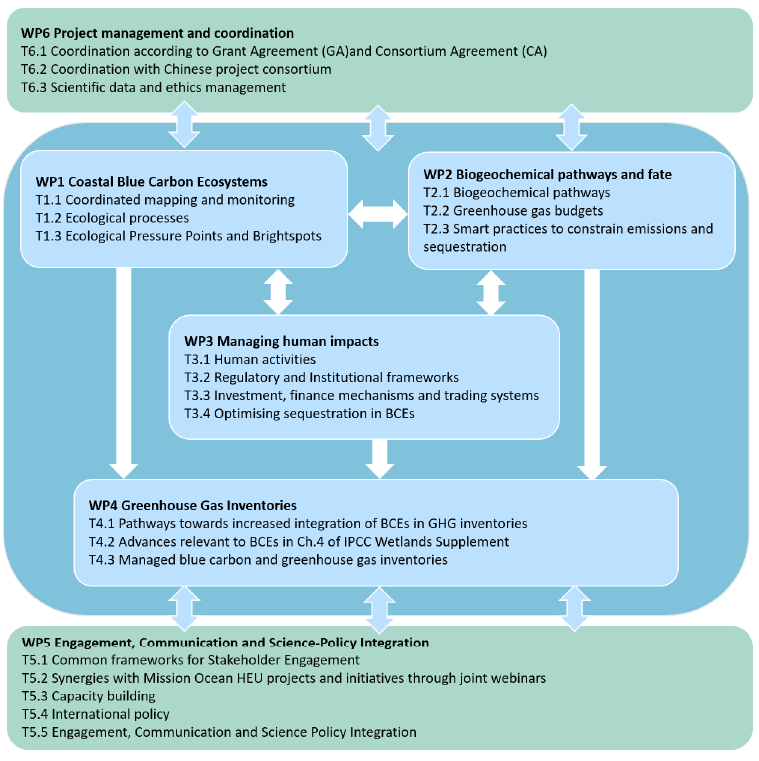
To achieve these objectives, C-BLUES will carry out the following activities

  • Produce spatial maps, methodological best practices and standard operating procedures
  • Enable more robust and reliable quantification of carbon emissions and sequestration
  • Model sequestration capacity and upscale regional and global greenhouse gas budgets
  • Assess carbon stock changes, greenhouse gas emissions and removals related to different management interventions and human activities
  • Review legal and institutional frameworks governing blue carbon ecosystems
  • Assess the drivers and barriers for integrating coastal wetlands into national reporting mechanisms under the UNFCCC.


The Biogeotrace lab leads WP2: Biogeochemical Pathways and Fate

Aims and objectives:

  • Innovate & define best practices for measuring, modeling, and monitoring emissions and removal of GHGs from BCEs
  • Reduce uncertainty in quantifying emissions and sequestration of GHG in BCEs
  • Estimate actual and project potential contributions of GHG emissions and removals by BCEs

WP2 consists of 3 Tasks

Task 2.1 Biogeochemical pathways

  • Quantify carbon and nitrogen fluxes in and out of key BCEs.
    • How: combining local experiments with global datasets
    • Outcome: informing models for projection, management, IPCC emission factors
  • Lead: Cale Andrew Miller (UU)


Task 2.2 Greenhouse gas budgets

  • Upscaling in space and time the sequestration capacity of BCEs
    • How: implementing a hierarchy of models considering habitat mapping, biogeographic modeling, and mechanistic representations of BCE modules.
    • Outcome: C budget at the coastal level and inform Earth System scale evaluations and feedback processes with the atmosphere
  • Lead: Momme Butenschön (CCMC)


Task 2.3 Smart practices to constrain emissions and sequestration

  • SOP for monitoring, reporting, and validating carbon sequestration and emissions in BCEs
    • How: aligned with CI Blue Carbon Manual; through workshop between WP1-WP2 and Stakeholder engagement in WP5
    • Outcomes: Report advising on how to evaluate, collate, and present assessments of BCEs, including guidelines for handling and recording data
  • Lead: Jack Middelburg (UU)

Duration

2024-2028

PI:

Ariane Arias-Ortiz (UAB)

Coordinator:

Norsk Institutt for Vannforskning (Niva)

Partners:

Norsk Institutt for Vannforskning (Niva) (NO), Akvaplan Niva As (APN) (NO), Universitat Autonoma de Barcelona (UAB) (ES), AZTI (ES), Bangor University (UK), Idryma Technologias Kai Erevnas (Forth) (EL), Max-Planck-Gesellschaft Zur Forderung Der Wissenschaften Ev (Mpg) (DE), Middle East Technical University (METU) (TR), Sorbonne Universite (FR), Centre National de la Recherche Scientifique (CNRS) (FR), Agencia Estatal Consejo Superior de Investigaciones Cientificas (CSIC) (ES), Goeteborgs Universitet (SE), Universita ta Malta (MT), The University Court of the University of St Andrews (USTAN) (UK), Universiteit Utrecht (NL), Fondazione Centro Euro-Mediterraneo Sui Cambiamenti Climatici (CMCC) (IT), Plymouth Marine Laboratory Limited (UK), Organisation des Nationes Unies pour L’education la Science et la Culture (Unesco) (FR), East China Normal University (Ecnu) (CN), South China Botanical Garden (SCBG) (CN), Zhejian University (CN)

Funders:

C-BLUES is a Horizon Europe Framework project funded under the Joint EU-ChinaFlagship Initiative on Climate Change & Biodiversity, call for EU-China international cooperation on blue carbon (HORIZON-CL5-2023-D1-02).